
Menu
As a country, we celebrate Black History Month, National Hispanic Heritage Month, and Asian Pacific American Month, amongst others – and yet, students hear about racism in the news almost every day while they are in the midst of making their own choices as to how they treat people themselves. For many reasons, I wanted my students to do a Cultural Diversity Bible Study to Celebrate every Tribe, Tongue & Nation!
I once had a student who would make these statements in an effort to get a laugh (some racist, others inappropriate, others just not funny). I am grateful I chose to have patience with him each time because later in the year, after one of these statements, I asked why he says these things. He said his dad says them… and after a few moments, he followed it up with, “I guess people don’t really find him funny either.” This 7th-grade boy was trying to be like his dad ( I get it), but it wasn’t being met with great response, and in 8th grade, I noticed a lot of those comments were no longer being made.
Because the Bible is our authority on everything, and our original text addresses racism, I wanted my students to invest some time in understanding how the Bible tells us that God celebrates our different Tribes, Tongues, and Nations, and anything less from us is an affront to God himself!
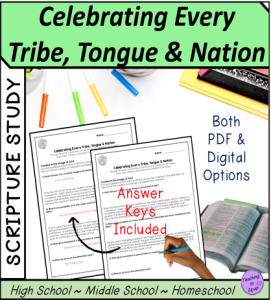
This reading comprehension activity asks students to answer questions as they read through the commentary. Along the way, they will also be looking up scriptures that align with the reading. This can be done as individual work, as group reading or used in conjunction with learning strategies such as jigsaw activities.
Biblical Texts Discussed
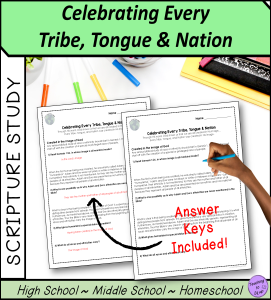
Of course, we can always use resources like these for students to do on their own, either in class or as homework… And it could serve a great purpose that way. But I actually prefer to use this as an in-class activity with my students interacting and discussing the text.
However I set up the activity, we usually end with TWO FINAL ACTIVITIES… The first is the review crossword puzzle, as students will interact with the content again as they complete the puzzle by reviewing the information from the readings. We finish with a moment for them to reflect and apply this to their own lives. I usually ask them to write down what in this activity has stuck out to them and explain why. Whether it is something new they learned or were just reminded of, having to explain why it sticks out to them requires them to think a little more deeply about this content.
While my student’s choices are still theirs, my hope is that after this activity, they will come to understand that treating ALL with dignity and respect is not just a nice thing to do or a good suggestion but a mandate from our Lord himself – as they see in this Cultural Diversity Bible Study.
Remember His grace for you as Teaching to Equip our students is hard, but holy work!
– Jamie
Click here to see over 600 resources to help your students spend time better understand scripture!

Hi! My name is Jamie. I have a degree in Bible & Theology and Youth Ministry and a Masters in Teaching.
I’ve worked with middle & high school students since 2002, and enjoy my iced coffee with a little white chocolate!