
Menu
Teaching biblical love can feel deceptively simple—until students start mixing everything together.
In middle school and early high school, students are still developing the ability to distinguish abstract concepts. When Scripture uses the same English word for different kinds of love, students often assume they all mean the same thing.
Helping students understand the different types of biblical love isn’t just about vocabulary—it’s about comprehension, theology, and application. When students grasp why scripture uses different words for love, they begin to see God’s character, relationships, and commands more clearly.
This breakdown of the four main types of biblical love is designed to help teachers and homeschool parents move beyond surface-level definitions and guide students toward deeper understanding.
Simply defining the four types of biblical love isn’t enough for most middle school students. To truly understand these concepts, students need structure, comparison, and application.
Define – Introduce each type of love with a clear, age-appropriate definition.
Locate – Show where each type appears in Scripture.
Compare – Help students see how these loves differ from one another.
Apply – Ask students to connect each type of love to real-life situations.
This approach helps students organize abstract ideas into meaningful categories instead of memorizing isolated facts.
Want a Guided Teaching Pack to Walk Through This Step-by-Step?
Grab the 4 Types of Biblical Love Activity Lesson Activity — includes questions, comparison charts, and real-world application prompts.
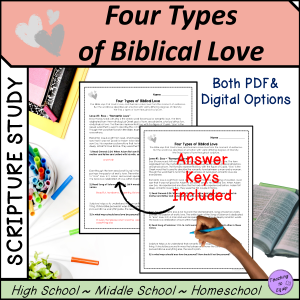
I love it when I can have my student learn biblical concepts while also practicing skills such as their reading comprehension, so that is one reason I love this 4 types of Biblical love activity.
I appreciate that my students are reading the commentary, and yet will also be in scripture and looking up the verses for themselves, helping them to realize they can read and understand scripture on their own too!
Through this activity, my students learn about Eros, Storge, Philia, and Agape love and see examples in scripture of each. In the Bible, we see the word “love” describing varying degrees of intensity – each Greek word characterizing “love” differently.
Eros, meaning “Romantic Love,” comes from the Greek word for sensual or romantic love, originating from the mythological Greek god of love represented by the symbol of cupid. Paul’s writings also teach us how this love is to be pursued within the context of marriage.
Storge, meaning “Familial Love,” is the Greek word used to describe the natural love that family members have for one another, most common from parent to child, such as Noah & Jacob’s families and the love sisters Mary and Martha had for their brother Lazarus.
Philia, meaning “Affectionate Love,” is the Greek term for meaningful connections, describing that powerful bond found in deep, meaningful friendships such as the friendship between David and Jonathan, and we see it between the disciples in the Gospels.
Agape, meaning “Unconditional Love,” is the highest type of love, defined by God’s incomparable love for humankind. A divine love coming from God himself is perfect, sacrificial, and pure, as we see in the person of Jesus. and his actions on the cross in the Gospels.
Classroom tip: Ask students to give one modern-day example of each type of love.

Depending on the class, it can be done as individual or partner work. The stand-alone crossword puzzle is a great additional activity for early finishers or for a day with a substitute!
Understanding the different types of biblical love helps students move beyond vague ideas of “being loving” and toward a clearer picture of how Scripture describes relationships, commitment, and God’s character.
When taught intentionally, this topic becomes more than a vocabulary lesson—it becomes a framework students can return to as they read Scripture, study Jesus’ teachings, and reflect on their own relationships.
If you’re looking for a structured way to teach biblical love—including guided questions, comparison activities, and application prompts—you may find it helpful to use a ready-made lesson framework designed for middle school classrooms and homeschool settings, like this 4 types of Biblical love activity
Remember His grace for you as Teaching to Equip our students is hard, but holy work!
– Jamie
Click here to see over 700 resources to help your students learn scripture!

Hi! My name is Jamie. I have a degree in Bible & Theology and Youth Ministry and a Masters in Teaching.
I’ve worked with middle & high school students since 2002, and enjoy my iced coffee with a little white chocolate!