
Menu
Teaching the Gospel of Luke to middle and high school students is an opportunity to help them see Jesus as a compassionate Savior. Luke’s gospel uniquely highlights Jesus’ ministry to the marginalized, His concern for the lost, and His call for His followers to show the same compassion to others. As teens are forming their identity, and becoming morally and socially aware of the world around them, Luke provides a powerful example of how faith is not just about belief—it’s about how we treat others.
Our students are developing empathy, wrestling with fairness, and seeking belonging, many begin to ask, “Does God really care about me?” “Where do I fit in?” “How should I treat others?” Luke’s gospel provides meaningful answers to these questions by emphasizing:
Jesus’ Compassion for the Outcast – Luke demonstrates Jesus reaching out to sinners, the poor, women, lepers, tax collectors, and Gentiles (people often ignored or rejected by society) reminding students that God’s love extends to everyone, including them.
The Importance of Mercy and Forgiveness – Luke records parables like the Good Samaritan (Luke 10:25-37) and the Prodigal Son (Luke 15:11-32), teaching that true disciples reflect God’s mercy, not judgment.
Faith in Action – More than just words, Jesus’ ministry in Luke is marked by action such as healing, feeding the hungry, and uplifting the brokenhearted helping students see that following Christ means living out their faith by serving others.
God’s Plan for All People – Luke traces Jesus’ genealogy back to Adam (not just Abraham, as in Matthew), emphasizing that salvation is for the whole world.
By studying Luke, students discover that Jesus isn’t just a distant figure. He’s a loving, compassionate Savior who cares deeply about them and calls them to extend that same love to others.
To help students connect with Luke’s message, use interactive and thought-provoking resources that encourage reflection, discussion, and application.

Gospel of Luke Bible Study Worksheets
These Gospel of Luke Bible Study Worksheets walk students through key passages, guiding them to explore Jesus’ parables, miracles, and teachings.
Why it works: My goal is for my students to be reading scripture for themselves. These worksheets help them think critically, reflect personally, and connect the text to their daily experiences.

Hi! My name is Jamie. I have a degree in Bible & Theology and Youth Ministry and a Masters in Teaching.
I’ve worked with middle & high school students since 2002, and enjoy my iced coffee with a little white chocolate!
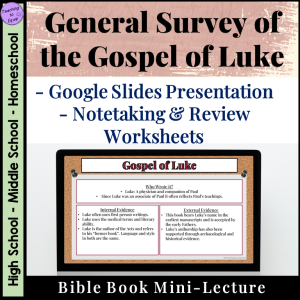
Gospel of Luke Lecture & Notes
This Gospel of Luke Structured Lecture Presentation provides a clear overview of Luke, including:
– Who wrote it, when it was written, where it was written, etc.
– The purpose of the Gospel of Luke
– A brief outline of the book
– A short explanation of 2 hard to understand verses in this book
Why it works: Many students need a big-picture framework before diving into details. This presentation helps them see the overall message of Luke and how it fits into the Bible’s story.
Luke Review Activity Worksheets
This brief review of the Gospel of Luke uses the Observe, Interpret, & Apply principles (including personal reflections) as students interact with scripture through multiple choice, matching questions, key terms word search, etc.
Why it works: With a variety of question types and activities and personal reflections connecting their lives with scripture, students are engaging with biblical truths.

Luke Crossword & Word Search Puzzle Activity
These book of Luke crossword & wordsearch puzzles are a fun, low-pressure way to review Mark’s key names, places, and themes. It’s perfect for:
– Lesson starters to introduce the book
– Review days to reinforce past learning
– Independent work for students who finish early
Why it works: Teens enjoy challenges and problem-solving, making puzzles a fun way to reinforce Bible knowledge.

The Gospel of Luke teaches that compassion isn’t optional—it’s central to following Christ. But what does this look like for teens today?
Compassion means reaching out to those who feel excluded.
– Jesus ate with sinners, welcomed outsiders, and healed the broken. Students can apply this by including the lonely, standing up for the bullied, and showing kindness to those who are different.
Compassion means forgiving instead of holding grudges.
– The Prodigal Son teaches that God welcomes back the lost with open arms. Teens face conflicts daily—Luke shows them that grace is more powerful than revenge.
Compassion means serving others.
– Jesus didn’t just talk about love—He demonstrated it through action. Encourage students to look for ways to serve their families, communities, and classmates with humility.
Bringing Luke’s message to life in your classroom isn’t just about head knowledge—it’s about heart transformation teaching the next generation discover the life-changing compassion of Jesus.
Remember His grace for you as Teaching to Equip our students is hard, but holy work!
– Jamie
Click here to see over 600 resources to help your students learn scripture!