
Menu
A simple way to choose content that builds biblical literacy and keeps students engaged!
If you’ve ever planned a middle school Bible class and felt torn between “fun lessons” and “serious Bible study,” you’re not alone. Middle schoolers need both: they’re curious, concrete thinkers who thrive with structure, but they also need lessons that feel meaningful and relevant.
The biggest mistake most of us make is starting with random topics (“Let’s do prayer this month”) or favorite stories (“Noah! David! Daniel!”) without a plan for how it all connects.
Middle school Bible class works best when you aim for confidence and connection:
Quick free starting point: If you want the big-picture structure first, grab the FREE Bible Curriculum Map (Grades 6–12)
In grades 6–8, students don’t need you to “cover everything.” They need a framework that answers:
So the question isn’t “What should I teach?” as much as “What foundation do my students need by the end of middle school?”
A simple way to keep your year balanced (and prevent “random Bible class”) is organizing Scripture into units. Here’s a middle school-friendly structure that helps students see the whole Bible as one story:
This structure gives you a clear “container” for lessons—so you can teach with coherence even if your schedule changes.
Middle school curriculum decisions get a lot easier when you run everything through three filters:
1) Story filter: Does this help students understand the big story?
Middle schoolers need repeated practice connecting dots: creation → fall → covenant → rescue → kingdom → Jesus → church → hope.
2) Literacy filter: Does this build Bible skills?
Choose lessons that build skills like:
3) Life filter: Can students apply this concretely?
Keep application practical: friendships, integrity, choices, identity, service, trust.

Hi! My name is Jamie. I have a degree in Bible & Theology and Youth Ministry and a Masters in Teaching.
I’ve worked with middle & high school students since 2002, and enjoy my iced coffee with a little white chocolate!
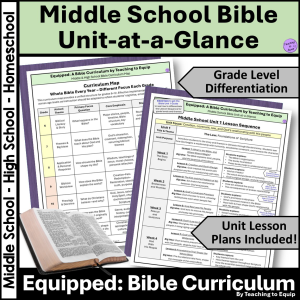
Most teachers don’t struggle because they lack ideas, they struggle because they need pacing and flow. That’s why a Unit-at-a-Glance is so helpful for teaching middle school.
The Middle School Unit-at-a-Glance helps you:
Grab the Middle School Unit-at-a-Glance!
Once you know the weekly flow, the next need is teaching confidence: “What do I do tomorrow to teach this well?”
That’s where Unit Guides come in. They support:
See if these would be helpful and check out the Unit 1 Guide.
Bottom line for middle school: If you’re unsure what to teach, don’t start with topics. Start with a story-based plan that builds literacy and confidence. Middle school Bible class is about forming a foundation students can build on for life.
Remember His grace for you as Teaching to Equip our students is hard, but holy work!
– Jamie
Click here to see over 700 resources to help your students learn scripture!