
Menu
If you’ve ever sat down to plan Bible class and thought, “Where do I even start?”—you’re not alone. Bible teachers are often expected to teach the whole story of Scripture, keep lessons age-appropriate, connect to real life, and somehow make it all fit into a school calendar… without a clear long-term plan.
That’s exactly why I created a free Bible Curriculum Map for Grades 6–12: A year-at-a-glance scope & sequence that shows the big picture and helps you teach with purpose—without locking you into a scripted curriculum.
Grab the FREE Bible Curriculum Map (Grades 6–12) – Get it Here!
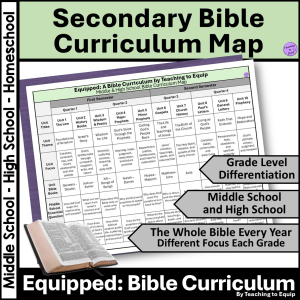
A curriculum map doesn’t replace your lessons—it supports them.
It gives you the big picture so you can make better decisions about what to teach, what to emphasize, and how each unit fits into the overall story of Scripture. When you can see the year (and the multi-year progression) at a glance, planning becomes less stressful and teaching becomes more purposeful.
A strong curriculum map helps you:
Choose (or create) lessons that align with clear objectives
Equipping teachers. Engaging students. Teaching Scripture
This entire curriculum system is built on one simple idea: Bible instruction should equip students, not just inform them. That means our goal isn’t only “coverage.” Our goal is long-term growth:
This is why the curriculum map uses a “whole Bible, every year” approach with different grade-level themes and focuses. Students revisit the same Scripture, but through a deeper lens as they mature—so it’s not repetitive. It’s developmental.
A lot of scope & sequences simply list books of the Bible. Helpful, but not enough. This curriculum map includes grade-level themes and focuses so you can teach the same Bible with different depth year to year.
Middle School (Grades 6–8): Building Foundations Middle school students benefit from:
– Clear story connections
– Guided comprehension
– Vocabulary support
– Concrete application
Hi! My name is Jamie. I have a degree in Bible & Theology and Youth Ministry and a Masters in Teaching.
I’ve worked with middle & high school students since 2002, and enjoy my iced coffee with a little white chocolate!
At this stage, the goal is confidence and clarity—helping students know Scripture is understandable and connected.
High School (Grades 9–12): Deepening Thinking and Ownership High school students are ready for:
– More interpretation and synthesis
– Worldview and theology discussions
– Evidence-based answers from Scripture
– Meaningful written responses
At this stage, the goal is depth and ownership—helping students think biblically in a complex world.
The map works in all contexts—it just changes how long you spend in each unit. Here’s the simplest way to use it:
Step 1) Start with your setting and schedule. How often do you teach?
– Daily (school)?
– Weekly (church/youth group)?
– 2–3x per week (homeschool co-op)?
Step 2) Choose your grade-level lens. Pick the grade you teach and let that annual focus guide:
– What you emphasize
– How deep you go
– What kinds of questions you ask
Step 3) Use the units as “containers”. Plan your year by mapping units onto:
(This keeps the year coherent even if you have interruptions.)
– Quarters
– Semesters
– Months
– or weeks
Step 4) Plug in what you already use. Once the structure is set, you can:
– Choose readings
– Use your favorite activities
– Build discussions
– Assign assessments
The map gives the “spine.” You add the “muscle.”
A curriculum map gives the big picture. But many teachers ask the next question: “Okay… what does this look like week-to-week?”
That’s why I created the Unit-at-a-Glance companion resources for both middle school and high school.
What the Unit-at-a-Glance provides
– A weekly plan that fits naturally into quarters/semesters
– Unit themes and focus statements
– Student-friendly objectives
– Essential questions (designed for the age level)
– Suggested lesson sequence for pacing and flow
If your biggest challenge is pacing and consistency, this is your next step after the map!
(Check out the High School Unit-at-a-Glance here, or the Middle School Unit-at-a-Glance here)
This curriculum system includes Unit Guides too!
This is for the teacher who is thinking: “I want to teach this unit with more depth—without spending hours reinventing everything.”
Unit Guides help you teach each unit with:
– Clear goals and focus
– Scripture-centered reading strategy
– Discussion guidance
– Application ideas that feel relevant (not forced)
– Assessment differentiation (formative and summative options)
– Alignment back to the curriculum map and Unit-at-a-Glance
(Check out the High School Unit 1 Guide, or the Middle School Unit 1 Guide)
Do I need to teach every unit every year?
Not necessarily. The map is designed for full-year use, but can be adapted:
– For semester programs
– For weekly youth group pacing
– For shorter class schedules
Is this more for school or church?
Both. It works well in Christian schools, youth ministry settings, and homeschool contexts.
Is this aligned to a specific denomination?
The map is designed to be broadly useful for Christian Bible instruction while keeping Scripture central. Teachers and schools can adapt emphasis and doctrinal specifics as needed.
Is it okay if I already have my own lessons?
Yes—this map is designed for that. It helps you organize and align what you already use so your year has coherence and progression.
If planning Bible class has felt overwhelming, this will give you a starting point that’s clear, realistic, and flexible.
Download the FREE Grades 6–12 Bible Curriculum Map Get it here!
Remember His grace for you as Teaching to Equip our students is hard, but holy work!
– Jamie
Click here to see over 700 resources to help your students learn scripture!