
Menu
Teaching the Gospels in middle school Bible classes is an opportunity to introduce students to the life, teachings, and ministry of Jesus Christ. The Gospels—Matthew, Mark, Luke, and John—are foundational Biblical texts, offering unique perspectives on the person and work of Jesus.
As a Bible teacher, it’s crucial to equip students with an understanding of how to study the Gospels, why these books were chosen, their purpose, the importance of understanding their structure, and the distinctions between the synoptic Gospels and the Gospel of John. This is why I often begin our study of the New Testament or Gospels, with this “How to Study the Gospels” mini-lecture.
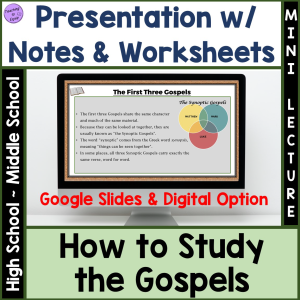
Firstly, it’s essential to explore why these four Gospels were included in the Bible. The early Christian communities recognized the significance of preserving the eyewitness accounts and teachings of Jesus through written accounts. The Gospels were chosen based on their apostolic authority, theology, and widespread acceptance among the early church. These books were considered essential for conveying the message of salvation and nurturing the faith of believers.
The purpose of each Gospel is key to comprehending their significance. While all four Gospels share the common goal of proclaiming the Good News of Jesus Christ, they also have distinct emphases and audiences.
I use this “How to Study the Gospels” mini-lecture resource to help my students understand how the structure of the Gospels is vital for interpreting and teaching these texts effectively. Each Gospel has its own unique structure, which serves to organize the material and convey the author’s intended message.
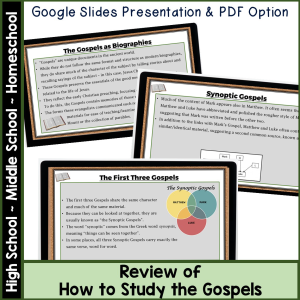
Three of the Gospels—Matthew, Mark, and Luke—are known as the synoptic Gospels because they share similar content, structure, and chronological sequence. These Gospels often parallel each other in their accounts of Jesus’ life, teachings, and miracles. The term “synoptic” is derived from Greek words meaning “together” and “to see,” highlighting the commonalities between these Gospels.
In contrast, the Gospel of John stands apart from the synoptics in both style and content. While the synoptic Gospels focus primarily on Jesus’ earthly ministry, John’s Gospel delves into the eternal significance of Jesus’ identity as the Son of God. Rather than presenting a chronological narrative, John organizes his Gospel around a series of theological themes, such as belief, signs, and the “I am” sayings of Jesus.
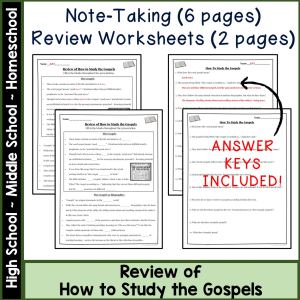
This “How to Study the Gospels” activity can be done in typical lecture format, using the note-taking handouts, or as individual work as students complete the activity by reading through the lecture slides on their own. After this, I assign the review worksheets to students to complete as a review of the material – sometimes by themselves, other times with a partner.
Teaching the Gospels requires sensitivity to the diverse perspectives, audiences, and purposes of each Gospel. By equipping students with an understanding of why these books were chosen, their purpose, the importance of understanding their structure, and the distinctions between the synoptic Gospels and the Gospel of John, we can empower students to engage with scripture and deepen understanding and faith, grounded in the Good News of Jesus Christ.
Remember His grace for you as Teaching to Equip our students is hard, but holy work!
– Jamie
Click here to see over 600 resources to help your students learn scripture!

Hi! My name is Jamie. I have a degree in Bible & Theology and Youth Ministry and a Masters in Teaching.
I’ve worked with middle & high school students since 2002, and enjoy my iced coffee with a little white chocolate!