
Menu
If you teach Bible in a Christian school, in your Homeschool, or at your church, you’ve probably run into this problem. By the time students reach 10th or 11th grade, they’ve heard the story of David and Goliath so many times that they quickly check out. Meanwhile, huge portions of Scripture never get real classroom time at all.
It’s not a discipline problem. It’s a scope problem.
Bible curriculum is typically built one year at a time, or it only focuses on middle or high school and ends up repeating itself, or teachers don’t have any curriculum and are just doing their best. The result is a lot of repetition in the familiar stories (Creation, Noah, Exodus, the Gospels) and almost no attention to the parts of Scripture that are harder to teach. Students graduate having heard the greatest hits on repeat, but they’ve never actually read through the whole Bible.
Here’s the shift that changes everything: instead of asking “what should I teach this year,” ask “what has already been taught, and what’s still missing?”
When you map Bible instruction across grades 6–12 as a single seven-year arc, you can cover the entire narrative of Scripture – Genesis through Revelation – adding new depth each year. Younger students get the foundational narrative and biblical literacy. Older students move into interpretation, theology, and worldview application. Nobody’s bored because we aren’t re-teaching what they already know but are approaching the same content through a new lens.
This is the framework behind our Bible Curriculum Map: 10 thematic units, each grade with a distinct annual focus, moving students through the whole counsel of Scripture.
Unit 1: Foundations of Scripture (Genesis–Deuteronomy)
Unit 3: Wisdom and Poetry (Job–Song of Solomon)
Unit 10: Hope and Restoration (Revelation)
…and everything in between – historical books, prophets, Gospels, epistles – each assigned a home in the sequence rather than competing for attention every year.
A few reasons this approach holds up over time, even with staff turnover or curriculum changes:
It gives every teacher a “what came before” reference point. A 9th grade teacher doesn’t have to guess whether students already covered the Exodus narrative in depth, because they know they did in 6th grade. (Real World Tip: There are always students who just joined us this year and didn’t get that background teaching. Pay attention to those students, and help them not feel isolated due to their lack of Biblical knowledge.)
It naturally differentiates by developmental readiness. Middle schoolers need story, comprehension, and concrete application. High schoolers are ready for interpretation, apologetics, and harder theological questions. A whole-Bible map lets the content progress in complexity right alongside the students, rather than teaching the same stories at a slightly higher reading level each year.
It protects the parts of the Bible that usually get skipped. Books like the Minor Prophets rarely get dedicated unit time when the curriculum is planned year by year. (There is already so much content to cover each year!) Mapping out the whole Bible in advance forces those books onto the calendar rather than leaving them as afterthoughts.
It gives your program a coherent story to tell parents and administrators. “Our students study the entire Bible over seven years, with a clear developmental progression” is a much stronger pitch than “we cover different books each year.”
You don’t need to rebuild your entire Bible program in one sweep. Start with these three steps:
1) Take inventory. List what each grade currently teaches, book by book. You’ll likely find both overlap and some gaps.
2) Assign each grade/year a theme for approaching scripture. This doesn’t have to be permanent, but a rough draft. (Real World Tip: In small schools or youth groups, middle and high school grade levels are often combined… in this case, teach scripture in a rotation of themes – a new theme each year.)
3) Build outward from there. Once you can see the whole arc, individual units and lessons get much easier to plan, because you know exactly what role they play in the bigger picture.
If you’d rather skip the inventory process and start from something already built, that’s exactly why I created the free Bible Curriculum Map. A 6-12 scope and sequence organized into 10 units, so you can see the whole-Bible framework at a glance and adapt it to your own program.
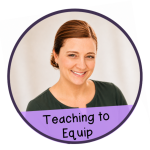
Hi! My name is Jamie. I have a degree in Bible & Theology and Youth Ministry and a Masters in Teaching.
I’ve worked with middle & high school students since 2002, and enjoy my iced coffee with a little white chocolate!
Whether you use it as-is or as a starting point for your own scope and sequence, having the whole picture in front of you is the first step toward a Bible program where every year builds on the last.
Remember His grace for you as Teaching to Equip our students is hard, but holy work!
– Jamie
Click here to see over 800 resources to help your students learn scripture!