
Menu
A clear plan for depth, discussion, and discipleship without a scripted curriculum
High school Bible class is different. Students are old enough to ask real questions:
If your plan is only “cover content,” you’ll feel behind before the first quarter ends. High school students need content, yes—but more than that, they need interpretation, integration, and formation.
So instead of asking, “What chapters should I teach?” consider the higher-level question: What do I want students to be able to do with Scripture by the end of this year?
Start with the free big-picture framework: Download the FREE Bible Curriculum Map (Grades 6–12)
In high school, students should grow in three areas:
1) Interpretation
They learn to read carefully, notice context, and support claims with Scripture.
2) Theology & worldview
They connect passages to major truths: God, humanity, sin, redemption, kingdom, church, hope.
3) Integration
They apply biblical truth to real life and culture—not with hot takes, but with wisdom.
High school Bible class works best when it’s not just “answers,” but biblical reasoning.
A practical, high-impact approach is still to organize your year into units, but teach each unit with a more mature lens. This creates a course that is structured enough to guide you but flexible enough for your teaching style.
The high school “depth shift”: Same Bible, new expectations. You don’t need brand-new content every year. You need deeper expectations. Here are three ways to raise the level:
1) Move from “What happened?” to “What is the author teaching?”
2) Require evidence from Scripture. High school students can learn to say:
3) Use essential questions to guide discussion
Example:
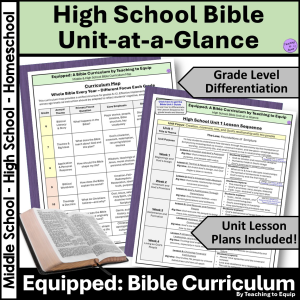
High school pacing breaks down when teachers try to do “college-level depth” with no roadmap. A weekly Unit-at-a-Glance helps you:
Grab the High School Unit-at-a-Glance here!

Hi! My name is Jamie. I have a degree in Bible & Theology and Youth Ministry and a Masters in Teaching.
I’ve worked with middle & high school students since 2002, and enjoy my iced coffee with a little white chocolate!
Once the weekly plan is set, the next question is practical: How do I lead strong discussion, application, and assessment for this unit?
That’s what Unit Guides are designed to support:
See if these would be helpful and check out the Unit 1 Guide.
Bottom line for high school: High school Bible class is an opportunity to equip students to interpret Scripture, form a Christian worldview, and integrate faith into real life. A clear unit structure + a weekly plan makes that sustainable.
Remember His grace for you as Teaching to Equip our students is hard, but holy work!
– Jamie
Click here to see over 700 resources to help your students learn scripture!